Custom plush packaging is the line item buyers often think about last and retailers check first. The cost depends on the selling channel: a polybag with a hang tag is simple, while a printed gift box with a window adds separate print work, assembly labor, carton volume, and often its own supplier MOQ.
This guide walks the options from cheapest to richest, what each adds to the quote, and the labeling that has to be on the product no matter what wraps it. The Plush Maker is an owned plush factory in Dongguan, manufacturing custom plush since 1998; packaging is quoted as its own line on every itemized quote we issue.
Key Takeaways
- Packaging cost depends on the route: polybag + hang tag is the lean option, while printed window boxes add tooling, assembly labor, and carton volume.
- Custom printed boxes carry their own supplier MOQ (often 500+), which can quietly become the binding minimum on small orders.
- Sewn-in labels (fiber content, origin, CPSIA tracking) are compliance, not packaging — they’re required even on a naked plush.
- Packaging decides carton density: boxed plush takes more cube than polybagged plush, and you pay the ocean by the cubic meter.
What Custom Plush Packaging Options Should Buyers Compare?
| Option | What it is | Cost impact | Typical use |
|---|---|---|---|
| Polybag (OPP/self-seal) | Clear bag, suffocation warning printed | Lowest | E-commerce, promos, crane/amusement |
| Polybag + hang tag | Adds printed swing tag with branding/barcode | Low | Most B2B and online retail |
| Header card bag | Polybag with stapled printed header for peg display | Low–mid | Impulse retail, grocery/value channels |
| Belly band / hang card | Printed wrap or backing card, plush visible | Mid | Mid-market retail shelving |
| Printed box (closed or window) | Full custom carton, often with PET window | Highest | Gift lines, licensed product, premium retail |
| Display-ready cartons (PDQ/CDU) | Shipper that converts to a shelf display | Mid–high (per program) | FOB retail programs, club stores |
Each step up buys shelf presence and unboxing value; each step also adds print tooling, assembly labor, and cube. The right answer comes from the channel: an Amazon-only product gains little from a window box that adds unnecessary freight volume.
What Does Each Option Actually Cost?
Packaging should be quoted as its own line because the cost drivers are different from sewing. A polybag is simple and usually low impact. Hang tags and header cards are print items with their own setup and minimums. Custom boxes are the jump: structural design, print plates, extra packing labor, and a box supplier whose own MOQ often starts around the same scale as the plush order.
That box MOQ matters more than its price on small orders: if you’re running 500 plush with a custom box, the box supplier’s minimum is binding at exactly your volume — and on anything smaller, packaging becomes the reason the whole project can’t shrink, a dynamic covered in how MOQ actually works. Boxes also add assembly labor (folding, inserting, windowing) that lands in the labor block.
Two quiet costs round out the picture. Barcodes and retailer-specific tags (price tickets, security tags) are cheap but must be in the spec before the run. And artwork revisions on printed packaging after plate-making cost real money — packaging art locks at the same time the golden sample does.
What Labeling Is Required Regardless of Packaging?
Three things live on the plush itself, sewn in, whether it ships naked or boxed:
- Fiber content and care label — material composition (e.g. “shell: 100% polyester; fill: 100% polyester fibers”) and washing instructions, in the destination market’s language.
- Country of origin — “Made in China,” permanently attached, legible at sale.
- CPSIA tracking label (US children’s products) — a permanent mark identifying manufacturer, production date/batch, and location, so a unit can be traced to its run.
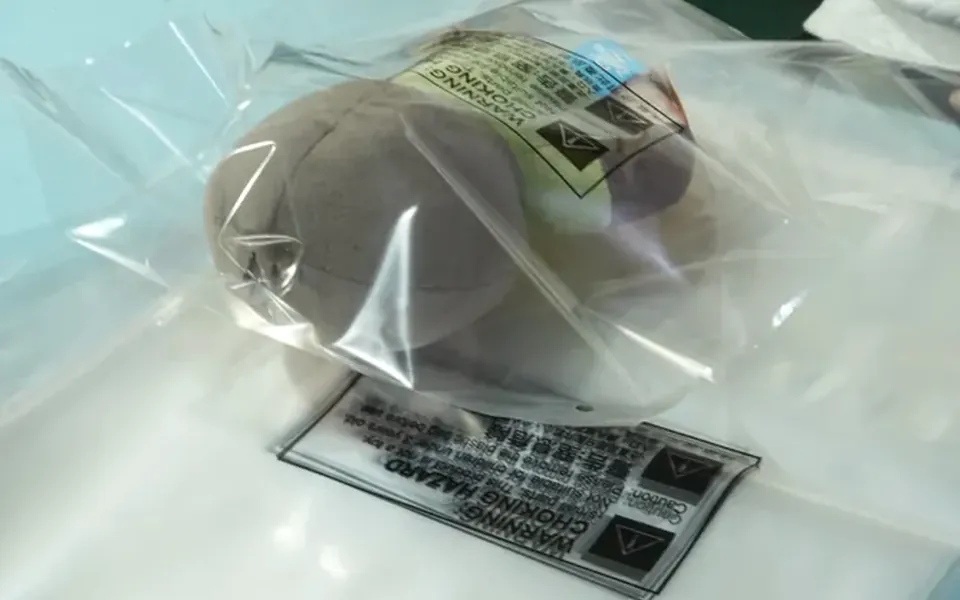
These are compliance items, not packaging choices — a missing tracking label fails a US shipment as surely as a failed test report. The polybag adds its own mandatory element: a printed suffocation warning in the legally specified format for thin-film bags. The wider regulatory stack is mapped in Plush Toy Safety Standards Explained.
If you’re selling into a specific major retailer, ask for their packaging compliance manual early. Carton markings, label positions, polybag thickness, and even staple bans (many retailers prohibit staples in header cards) are dictated documents, and reworking finished units to fix a carton label is misery that one email avoids.
How Does Packaging Change Freight Cost?
By the cubic meter. Sea freight prices on volume for goods this light, and packaging sets the volume: plush in polybags compresses into a master carton, while the same plush in rigid boxes ships at the box’s full cube. In our export work, that extra cube can change the freight calculation more than the packaging unit price itself on a 25–35 day sail.
The standard B2B pattern splits the difference: plush polybagged and densely packed for the ocean crossing, with flat-packed boxes shipped in the same container for assembly at the destination DC — or boxes assembled at the factory only for programs where the retailer requires shelf-ready goods. Which pattern fits depends on your warehouse setup; it’s a one-line question worth asking at quote stage, and the freight math belongs on the same itemized sheet as everything else in the pricing guide.
How Should You Spec Packaging in Your Order?
Five lines in the brief settle it:
- Channel — e-commerce, specialty retail, mass retail, club. This alone points to the right option.
- Packaging type and finish — e.g. “self-seal polybag + 2-side printed hang tag, matte,” or “window box, 350gsm, matte lam.”
- Artwork ownership — who designs the tag/box; factories can adapt your dielines or supply templates.
- Required marks — barcode (and who issues it), suffocation warning, retailer ticket requirements.
- Carton spec — units per master carton, max carton weight, any retailer carton-marking rules.
Send that with your artwork when you request a quote, and packaging arrives as a priced line you can compare across suppliers instead of an “included” mystery.
Request a Factory-Direct Quote
The first step in making your order come to life. Request a free quote with your artwork, target quantity, and sales channel — we’ll quote packaging as its own line, with dielines for whichever option fits.
Frequently Asked Questions
How much does plush packaging add to unit cost?
There is no useful flat percentage. A basic polybag and hang tag add little; printed header cards, inserts, and window boxes add tooling, assembly labor, and carton volume. Ask suppliers to quote packaging as its own line item so it does not disappear inside the unit price.
Do plush toys need packaging at all?
For shipping, only a polybag (with suffocation warning) to keep units clean — but the sewn-in labels are mandatory regardless: fiber content and care, country of origin, and for US children’s products a permanent CPSIA tracking label on the toy itself.
What’s the minimum order for custom printed boxes?
For many small B2B orders, printed box suppliers start around the same scale as the plush MOQ, so the packaging minimum can become the binding constraint. Confirm this before sampling. If the run is only 500 units, a polybag plus strong hang tag is usually safer than a custom box.
Should plush ship to my warehouse boxed or polybagged?
Polybagged and densely packed is usually cheaper on the ocean because plush can compress inside the master carton. Rigid boxes hold their full cube, so freight can become the real cost driver. Many programs ship plush bagged plus flat-packed boxes for destination assembly; shelf-ready retail programs assemble at the factory.
About the Author
Kyo Lue — General Manager, The Plush Maker
Kyo works directly with The Plush Maker’s sampling, packaging, QC, and export teams in Dongguan. His packaging advice comes from actual shipment decisions: carton fit, labeling, retailer requirements, suffocation warnings, freight volume, and final packing checks before export.