A custom plush quote usually arrives as one tidy number per unit. That number is doing a lot of work, and the items it quietly excludes are where budgets go wrong. Here’s the line-by-line anatomy of a proper quote, what should be itemized, and what almost never is.
The Plush Maker is an owned plush factory in Dongguan, manufacturing custom plush since 1998. We review B2B quote requests every week, and the questions in this guide are the ones buyers actually ask us. For how each cost is calculated, see the complete pricing breakdown.
Key Takeaways
- A complete quote itemizes unit price, sample fee, testing, packaging, and freight terms. A single bare number usually hides assumptions.
- Sample fees run $150–$300 per design, credited back on confirmed bulk orders of 3,000+ units.
- Quotes almost never include import duties, customs brokerage, or destination trucking. Check the incoterm before comparing numbers.
- Trading-company quotes often hide margin inside a single number, so compare quotes line by line, not total by total.
What Line Items Should a Custom Plush Quote Include?
A factory-direct quote should itemize at least five things: unit price at your quantity, sample fee, safety testing, packaging, and freight terms. In our experience, quotes that arrive as a single number are either incomplete or padded. Either way, you can’t compare them against anything.
| Line item | Typical range | Itemized by default? |
|---|---|---|
| Unit price (10-inch plush, 500 units) | $5–$7 per unit | Yes |
| Sample fee | $150–$300 per design | Yes |
| Safety testing | $150–$400 per standard per batch | Should be; often isn’t |
| Packaging | Depends on retail pack style and carton plan | Often bundled into unit price |
| Sea freight | Quoted by shipment, route, and timing | Quoted separately |
| Payment terms | 50% deposit, 50% balance | Stated in quote footer |
If a quote is missing the testing line and you’re shipping to the US or EU, ask why. The answer tells you a lot about the factory. Testing isn’t optional for retail, and “it’s included” with no lab name attached is not an answer.
What’s Inside the Unit Price?
The unit price itself is driven mainly by labor (40–50%), materials (25–35%), and QC (8–12%), with packaging and setup handled as separate quote assumptions when needed. We break down the main cost drivers in how much a custom plush toy costs, but the short version is simple: labor dominates, which is why panel count and embroidery complexity move the price more than size does.
This is also why quantity moves the number so much. Setup costs are fixed, so moving from 500 to 2,000 units typically cuts the unit price 30–40%. If your quote only shows one quantity, ask for a price ladder at 500 / 1,000 / 3,000 / 5,000 units. Any factory can produce that in minutes; ours includes it by default.
What’s Usually Not in the Quote?
The costs that surprise buyers are almost always on the destination side. A standard FOB quote covers production and delivery to the origin port, and nothing after the ship leaves. Not included:
- Import duties and tariffs. Set by your government, calculated on declared value. Your customs broker can estimate them before you order.
- Customs brokerage and clearance fees. Typically a flat fee per shipment on your side.
- Destination trucking. Port to warehouse is your cost under FOB terms.
- Licensing or royalty fees. If you’re producing licensed IP, that’s between you and the licensor.
- Design changes after pattern lock. Revisions within the sample process are included; reopening an approved pattern mid-production is not.
- Rush surcharges. Compressing a 25–45 day bulk timeline costs extra, and we’d rather tell you that upfront than miss a date.
The incoterm is the single most important word on the quote. EXW means you collect from our factory gate. FOB means we deliver to the port in China. DDP means we handle everything to your door, duties included, for a higher all-in price. Two quotes with different incoterms can look very different while describing identical plush.
How Do Sample Fees Work?
Sample fees run $150–$300 per design, covering pattern design, materials, and hand-sewing by our most experienced team members. The fee is credited back against confirmed bulk orders of 3,000+ units. Below that threshold, it stands as billed, because a sample is real engineering work whether or not an order follows.
Your quote should state the sample fee, what it includes, how revisions are handled, and the credit policy in writing. A factory that waives sample fees entirely is recovering that cost somewhere else in the quote, usually in a padded unit price you can’t see.
Comparing Two Quotes: Line by Line, Not Total by Total
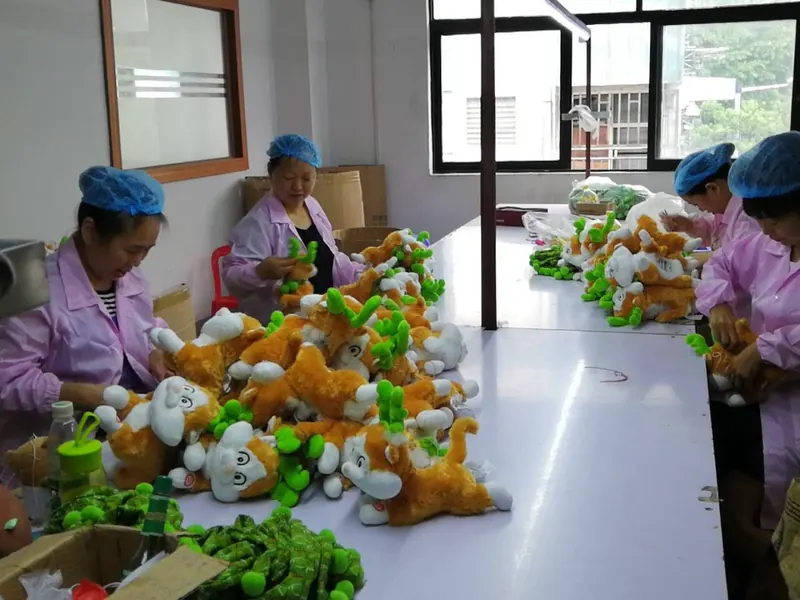
Trading-company margin hides easily inside a single-number quote. The only fair comparison is line by line at the same quantity, the same size, the same fabric, and the same incoterm. In our own quote reviews, the cheapest-looking offer is often just missing testing, packaging, or destination-side costs.
Practical checklist when two quotes disagree:
- Normalize the incoterm. Convert both to FOB or both to DDP before comparing.
- Match the spec. A lower quote for an 8-inch plush is not cheaper than a higher quote for a 10-inch plush.
- Find the testing line. If one quote includes third-party testing at $150–$400 per standard per batch and the other does not, the gap is not savings.
- Ask who owns the factory. A supplier who can’t name the factory address or offer a video call from the floor is reselling. Our vetting checklist is in how to choose a custom plush manufacturer.
Red Flags That Should Stop a Deal
Some quote patterns reliably predict problems later. “Free certification” means expired or borrowed test reports, which fail at customs. A quote with no stated payment terms invites renegotiation after your deposit. And a unit price far below the $5–$7 benchmark for a 10-inch plush at 500 units means the spec was quietly downgraded: thinner fabric, lighter stuffing, or skipped QC.
None of these require expertise to catch. They just require the quote to be itemized, which is exactly why vague quotes exist.
Request a Factory-Direct Quote
The first step in making your order come to life. Request a free quote with your artwork, target quantity, and destination market. You’ll get an itemized reply after we review the spec: unit price ladder, sample fee, testing stack, packaging, and freight terms, with nothing left to surface later.
Frequently Asked Questions
How long is a custom plush quote valid?
Our quotes are valid for 30 days. Fabric and freight prices move, so a quote older than that gets re-confirmed before deposit. If a supplier honors a six-month-old number without re-checking, the original quote had enough padding to absorb the drift.
Why do quotes from different suppliers vary so much?
Three reasons show up most often in our quote reviews: supplier type, incoterms, and missing inclusions. A factory-direct FOB quote cannot be compared against a DDP quote from a reseller unless freight, duties, testing, packaging, and destination costs are normalized first.
Is shipping included in a custom plush quote?
Usually not in the unit price. Sea freight is quoted separately because the cost depends on carton volume, route, destination port, season, and sailing date. A DDP quote bundles freight, duties, and local delivery into one all-in number, so compare the incoterm before comparing totals.
Do I pay for the sample separately?
Yes. Sample fees run $150–$300 per design and are billed before the sample build. The fee covers pattern work, material preparation, hand sewing, and review time, then is credited back against confirmed bulk orders of 3,000+ units when the quote states that policy in writing.
What payment terms are standard for custom plush orders?
50% deposit to start bulk production and 50% balance before shipment is the standard pattern we use for B2B custom plush orders. Terms outside that pattern are not automatically wrong, but full payment upfront from a supplier you have not vetted is a risk you do not need to take.
About the Author
Kyo Lue — General Manager, The Plush Maker
Kyo works directly with The Plush Maker’s pattern room, sampling team, QC staff, and export team in Dongguan. His quoting advice comes from production decisions made on the factory floor: materials, stitching time, sample revisions, testing requirements, packing method, and realistic shipment terms.