Plush toy stuffing looks simple, but almost every commercial plush toy is filled with PP cotton, the factory shorthand for synthetic fiberfill, usually polyester staple fiber, sometimes combined with plastic pellets for weight and posture. The materials are simple. What separates a good plush from a disappointing one is density: how many grams of fill go into the shell, and whether that number is a written spec or an operator’s mood.
The Plush Maker is an owned plush factory in Dongguan, manufacturing custom plush since 1998. This guide covers what goes inside the toy and how to spec it so unit 4,800 feels like unit 1. It’s a spoke of our factory process guide.
Key Takeaways
- PP cotton fiberfill is the industry-standard plush stuffing; grades differ in fiber type (hollow vs. solid, conjugated vs. straight), which sets loft and recovery.
- Fill weight is a spec in grams, locked at the golden sample — never “stuff until it looks right.”
- Pellets add weight and sit-stability but must be sealed in an inner pouch, never loose in the body; loose pellets are a compliance failure for children’s products.
- Under-stuffing reads as cheap, over-stuffing strains seams and hardens the touch; both are QC defects against the golden sample at AQL 2.5.
What Is PP Cotton in Plush Toy Stuffing?
PP cotton is the trade name for polyester fiberfill — fine synthetic fibers blown into the shell as a cloud of loft. It’s standard because it does everything a plush fill must do: it’s lightweight, resilient, washable, hypoallergenic compared to natural fills, inexpensive, and consistent batch to batch.
Within “PP cotton” there are real grade differences. Hollow conjugated fiber — fibers with a hollow core and a spiral crimp — lofts higher and recovers from squeezing better, and is the default for retail-grade plush. Straight, solid fiber packs denser and cheaper, and shows up in low-cost promo goods where the toy gets hugged once. If two quotes differ and one can’t tell you which fiber it uses, that’s part of the gap.
Fill is part of the materials share of unit cost (25–35% in total), and the grade difference is cents per unit. Downgrading fill to save money is one of the worst trades in plush: buyers can’t see the fiber, but they feel it instantly.
How Do Plastic Pellets Work in Plush?
Pellets — small PE/PP beads — do two jobs fiberfill can’t: they add weight, and they pool at the bottom so a toy sits upright instead of flopping. A beanbag-bottom plush is the classic use; weighted comfort plush is the growing one.
The non-negotiable rule: pellets go in a sealed inner pouch, stitched closed, inside the shell — never loose in the body cavity. A loose-pellet toy that pops a seam pours small parts onto the floor, which for children’s products is an instant safety failure. The sealed-pouch construction is also what compliance labs check first on weighted designs; the regulatory side lives in Plush Toy Safety Standards Explained.
Spec pellets the same way as fiber: pouch weight in grams, pouch position, and pouch fabric. “Some beans in the bottom” is not a spec.
Why Is Fill Density a Spec, Not a Feel?
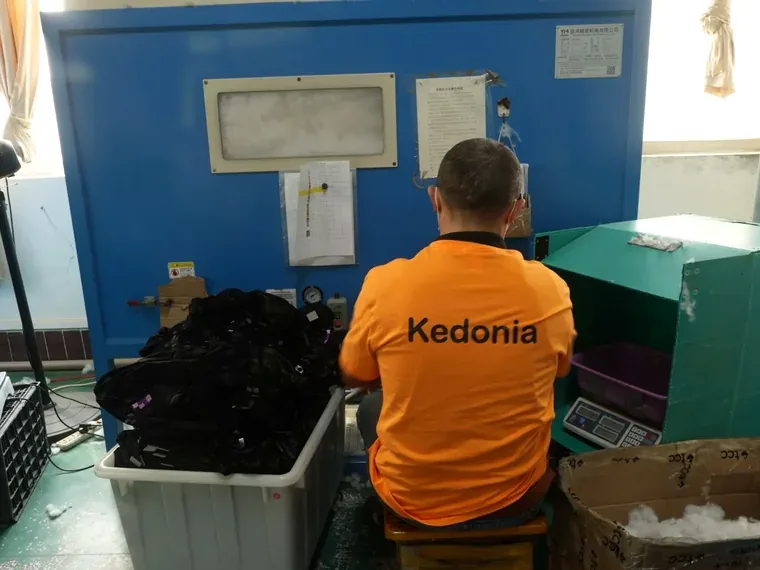
Because “stuffed until it looks right” produces a different toy on every shift. On our lines, every design has a fill weight in grams, set at the sample stage and locked with the golden sample. The stuffing machines meter fill by weight, and QC spot-weighs finished units against the spec.
Density is also a design decision, not just a quantity:
| Density choice | Feel | Risk if wrong |
|---|---|---|
| Soft fill (lower g) | Squishy, floppy, huggable | Under-filled limbs look deflated; face loses shape |
| Standard fill | Holds form, still soft | The default for character plush |
| Firm fill (higher g) | Sculpted, stands/sits crisply | Strains seams, hardens touch, adds material cost |
The right answer depends on the product: a comfort plush wants soft body and standard head; a display mascot wants firm everywhere; a baby toy wants soft and seam-safe. Different zones of one toy can carry different densities — head firm so the face reads, body soft so the hug works. That zoning is set during sampling, which is one more reason the sample stage decides bulk quality.
What Goes Wrong When Stuffing Is Done Badly?
Three failure modes, all visible at final inspection if QC is real:
Under-stuffing. The shortcut a cost-squeezed line takes, because fill metered by weight is the easiest place to quietly save grams. The toy looks wrinkled and deflated, the face collapses, and the buyer’s customer feels cheated. This is also why a suspiciously low quote deserves the question “what’s the fill weight?” — it’s one of the line items that gets cut invisibly, like the others in what’s included in a quote.
Over-stuffing. Seams sit under permanent tension, so the toy that survives the factory pops at the carton-squeeze or the first hug. Embroidered faces distort as the panel stretches. Touch goes from plush to firm-pillow.
Inconsistency. The worst of the three for a brand: units vary across the run, so returns and reviews diverge. The fix is procedural, not heroic — metered fill, spot-weighing, and inspection against the golden sample at AQL 2.5, the same controls described in how plush toys are made.
How Should a Buyer Spec Stuffing in an Order?
Put four lines in the spec sheet, and you’ve removed the whole category of dispute:
- Fill material and grade — e.g. “hollow conjugated PP cotton,” plus certification if needed (OEKO-TEX certified fill is available and worth specifying for baby and EU-bound products).
- Fill weight in grams — per toy, and per zone if the design uses zoned density. Locked at golden sample.
- Pellet construction, if any — pouch weight, pouch position, sealed-pouch requirement stated explicitly.
- Tolerance — a sensible ±% on fill weight so QC has a pass/fail number.
If you don’t know the right gram number, that’s normal — it’s the factory’s job to propose one at sampling and yours to approve the feel. What matters is that a number exists before bulk. Sample fees run $150–$300 per design, credited back on confirmed bulk orders of 3,000+ units, and dialing in density is a core part of what that sample buys.
Request a Factory-Direct Quote
The first step in making your order come to life. Request a free quote with your artwork and target quantity — tell us how the toy should feel in the hand, and we’ll come back with a fill spec to match.
Frequently Asked Questions
What are plush toys stuffed with?
Almost all commercial plush uses PP cotton (polyester fiberfill), sometimes with PE/PP pellets in a sealed inner pouch for weight and sit-stability. Premium plush uses hollow conjugated fiber for better loft and recovery; budget promo plush often uses cheaper straight fiber.
Is PP cotton safe for children’s toys?
Yes, when it meets the applicable standards — fiberfill is covered by the toy’s overall testing (EN71, ASTM F963, CPSIA), and OEKO-TEX certified fill is available for stricter programs. The bigger child-safety issue is pellets: they must be sealed in an inner pouch, never loose.
How much stuffing goes into a plush toy?
It’s a per-design number in grams, set at sampling and locked with the golden sample — there’s no universal figure. A small keychain plush may take a few grams; a large display plush, hundreds. What matters is that your factory treats the number as a spec with a tolerance, not a feel.
Why do some plush toys feel cheap even when the fabric is fine?
Usually fill: under-stuffing or low-grade straight fiber that packs flat after a few squeezes. Fill is invisible on a product photo and cheap to shave, which makes it a favorite place for cost-squeezed quotes to cut. Ask for the fill grade and gram weight in writing.
About the Author
Kyo Lue — General Manager, The Plush Maker
Kyo works directly with The Plush Maker’s sampling team, sewing line, stuffing station, and QC staff in Dongguan. His stuffing advice comes from production controls buyers can verify: fill grade, gram weight, hand feel against the golden sample, metal detection, and final AQL inspection.