This is how plush toys are made inside our factory: a custom plush toy passes through roughly eight production stages between approved artwork and a sealed shipping carton: pattern engineering, fabric preparation, cutting, embroidery, sewing, stuffing, metal detection, and final inspection. Sewing alone accounts for 40–50% of the unit cost, which is why the process is still, at its heart, a skilled-labor craft.
This guide walks through every stage the way it actually happens on our floor. The Plush Maker is an owned plush factory in Dongguan, manufacturing custom plush since 1998, with capacity around 300,000 units per month. What follows is not a generic overview; it’s how your order moves through our building.
Key Takeaways
- A custom plush is built from 12–30 individually cut fabric panels; panel count drives sewing hours, and sewing hours drive 40–50% of the cost.
- The full journey runs 10–14 weeks: pattern and sample (~20 days door to door), bulk production 25–45 days, sea freight 25–35 days.
- Every unit passes through a needle/metal detector — a hard gate, not a spot check — before final inspection against the locked golden sample at AQL 2.5.
- The pattern is the product. Get the pattern right at sample stage and bulk production is repetition; get it wrong and no amount of QC saves it.
How Plush Toys Are Made: What Are the Factory Stages?
Eight stages, in fixed order: pattern engineering, fabric sourcing and inspection, panel cutting, embroidery and face details, sewing, stuffing and closing, metal detection, and final QC with packing. Sample-making runs the same stages once, at quantity one, which is why a sample predicts bulk quality so reliably.
| Stage | What happens | Typical share of unit cost |
|---|---|---|
| 1. Pattern engineering | Artwork becomes 12–30 2D panel shapes | Setup work, quoted separately |
| 2. Fabric prep | Dye-lot matching, inspection, relaxing | Materials: 25–35% |
| 3. Cutting | Panels cut by die or laser, bundled per unit | In materials/labor |
| 4. Embroidery & face | Eyes, nose, mouth, logos applied to flat panels | In labor |
| 5. Sewing | Panels joined inside-out, then turned | Labor: 40–50% total |
| 6. Stuffing & closing | PP cotton filled, hand-stitched closure | In labor |
| 7. Metal detection | Every unit through a needle detector | QC: 8–12% |
| 8. Final QC & packing | Inspection vs. golden sample at AQL 2.5 | QC: 8–12% |
The rest of this guide takes each stage in turn.
How Does Artwork Become a Plush Pattern?
Pattern engineering is the translation of a flat drawing into a set of 2D fabric shapes that, when sewn and stuffed, recreate the character in three dimensions. A typical custom plush uses 12–30 panels; a simple mascot might need 12, a complex character with limbs, ears, and a tail can exceed 30.
Our pattern team of six works in Gemini and StyleCAD, and this is the stage where experience shows most. Stuffed fabric stretches and rounds out, so a panel that looks correct flat will distort once filled. Good pattern engineers compensate for that distortion in advance; weak ones discover it at the sample stage and start guessing.
This is also why the pattern, not the sewing, is what separates manufacturers from resellers. A trading company can buy sewing capacity anywhere. It cannot fake an in-house pattern room. The day-by-day version of this stage is in From Sketch to Sample, and the fees and revision workflow are in the sample process guide.
What Fabrics Are Plush Toys Made From?
Most custom plush is made from polyester pile fabrics: minky (super-soft short pile), velboa (low pile, holds embroidery detail well), and longer piles for fur effects. Fabric choice affects feel, print fidelity, embroidery behavior, and cost — though materials in total are only 25–35% of unit cost, less than most buyers assume.
Before cutting, incoming fabric is checked against the approved lab dip for color. Dye lots vary, which is why color matching happens per order, not per catalog. Rolls are inspected for pile defects and left to relax so panels cut today are the same size tomorrow.
For a buyer’s comparison of minky, velboa, and pile lengths, see the plush fabric guide.
How Are the Panels Cut?
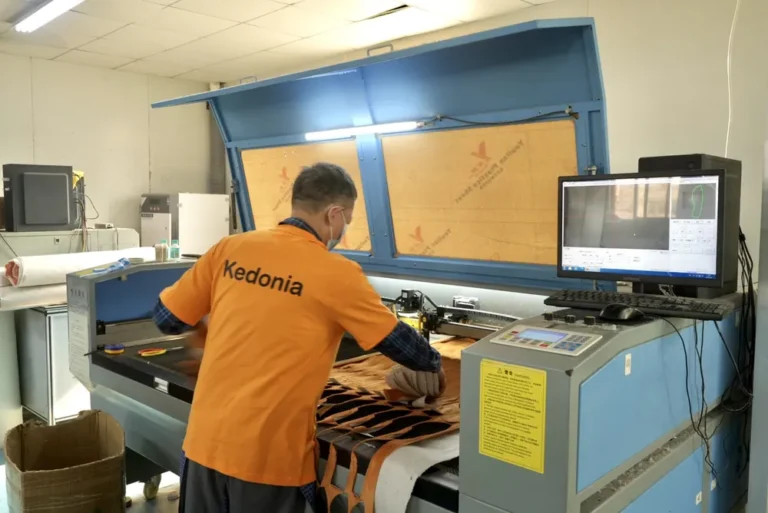
Panels are cut either with steel-rule dies for large runs or laser cutters for shorter runs and intricate shapes, then bundled into per-unit kits. Cutting accuracy decides whether seams meet correctly two stages later; a 2 mm error across 20 panels compounds into a visibly crooked face.
Pile direction matters as much as the outline. Plush fabric has a nap, and every panel must be cut with the nap running the agreed way, or the finished toy shows patchy, mismatched shading under light. Nesting software lays panels out to respect nap while minimizing waste — fabric yield is one of the real inputs behind MOQ math, covered in why unit price drops at volume.
How Do Plush Toys Get Their Faces?
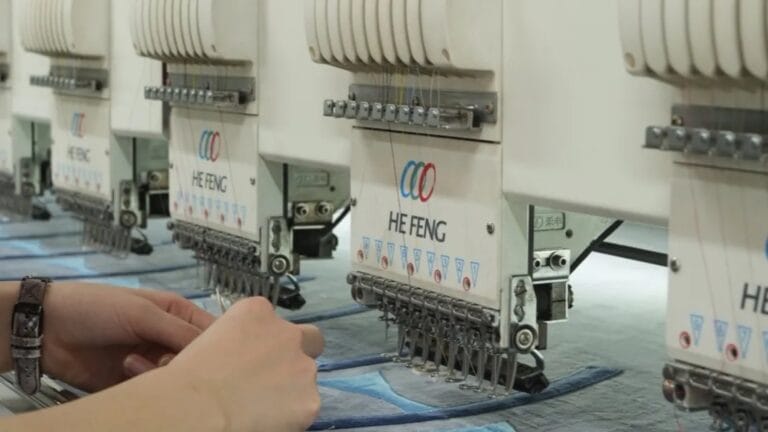
Faces go on while the panels are still flat. Embroidered eyes and mouths, appliqué patches, woven labels, and screen prints are all applied to individual panels before any sewing, because a flat panel can be clamped in an embroidery hoop and a sewn toy cannot.
Embroidery is digitized once per design — a setup cost — then runs on multi-head machines. Density matters: a heavily embroidered face can add more sewing-adjacent machine time than the rest of the toy combined, which is one reason a complicated 15 cm plush can cost more than a simple 30 cm one.
For toys using plastic safety eyes instead of embroidery, the eyes are inserted through the panel and locked with washers at this stage, before sewing, so the lock can be inspected from the back.
The embroidered vs. safety eyes vs. printed decision is covered in plush toy eyes compared.
Why Is Sewing Half the Cost of a Plush Toy?
Sewing is 40–50% of unit cost because it cannot be meaningfully automated. Each toy is sewn inside-out by an operator guiding curved seams through a machine, panel pair by panel pair, then turned right-side-out through a deliberately left opening. A 20-panel character passes through many hands before it ever sees stuffing.
Two facts follow from this. First, complexity beats size as a price driver: panel count and seam length set the sewing minutes, and sewing minutes set the price. Second, sewing skill is the capacity that’s genuinely scarce during peak season — it’s the reason Q2 launches need bookings confirmed by October, before the pre-Chinese New Year crush.
Sewn shells are inspected for seam integrity before stuffing, because a missed seam is cheap to fix now and expensive to fix after closing.
How Are Plush Toys Stuffed and Closed?
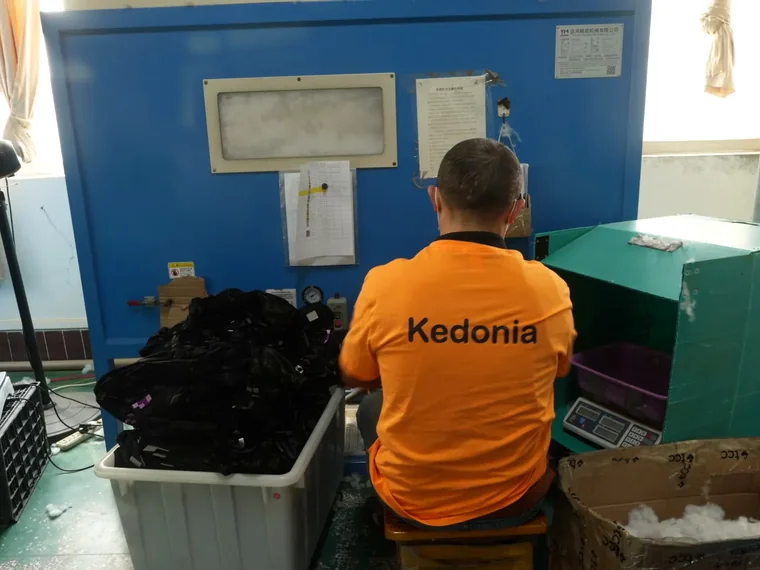
Stuffing machines blow PP cotton into the shell through the turning gap, with fill weight controlled per design — density is a spec, not a feel. Under-stuffed toys look deflated; over-stuffed ones strain seams and harden the touch. Weighted bases use plastic pellets sealed in an inner pouch, never loose in the body.
The closing stitch is done by hand. A hidden ladder stitch seals the turning gap so the closure disappears into the seam line. It’s a small detail, but it’s the one buyers run their thumb over first, and hand-closing quality is an instant read on a factory’s standards.
Fill materials and density standards are covered in the plush stuffing guide.
What Happens at Metal Detection and Final QC?
Every finished unit passes through a needle/metal detector — 100% of units, not a sample. The detector catches broken needle fragments, the single most serious physical hazard in sewn products, and any unit that triggers it is opened, cleared, and re-run. This is a hard gate; nothing ships around it.
Final inspection then checks finished toys against the golden sample — the locked, signed-off sample from your approval — at AQL 2.5 for general defects: face placement, seam quality, fill density, color match, label position. Third-party inspection (SGS, Intertek, or similar) is welcome on top of ours, and serious factories don’t flinch at it. The standards a compliant toy must test against are covered in Plush Toy Safety Standards Explained.
Passed units get hang tags, polybags or retail packaging, and carton packing to the agreed assortment, then move to the loading dock.
Packaging options and their costs are detailed in custom plush packaging.
How Long Does the Whole Process Take?
Plan on 10–14 weeks from approved artwork to goods at your warehouse, by sea. The build itself is the middle third; pattern/sampling at the front and freight at the back take the rest.
| Phase | Duration |
|---|---|
| Pattern + first sample | 7–14 days build (~20 days door to door) |
| Revisions | A few days to a week per round, 1–3 rounds typical |
| Bulk production | 25–45 days after golden sample lock |
| Sea freight | 25–35 days |
| Total | 10–14 weeks |
The compressible part is revisions — tight artwork and fast feedback save weeks. The incompressible parts are sewing and the ocean. Air freight can rescue a deadline, but at a multiple of sea cost; if you’re up against Q4, the calendar math matters more than any factory’s “fast turnaround” claim.
What Should Buyers Take From This?
Three things. First, pricing follows the process: labor 40–50%, materials 25–35%, QC 8–12%, which is why panel count moves your quote more than fabric grade does — the full breakdown is in the custom plush pricing guide. Second, the sample stage is the whole game: bulk production is the sample, repeated. Third, every stage above is visible on a video call, which is why a floor walkthrough is the single best vetting step in the manufacturer selection guide.
Request a Factory-Direct Quote
The first step in making your order come to life. Request a free quote with your artwork and target quantity. You’ll get an itemized quote within 24 hours, and we’re happy to show you any of these stages live from the floor.
Frequently Asked Questions
Are plush toys made by hand or by machine?
Both, in sequence. Cutting and embroidery are machine processes; sewing is operator-guided machine work, seam by seam; stuffing is machine-filled to a weight spec; and the final closure is stitched fully by hand. Labor is 40–50% of unit cost because the sewing stages resist automation.
How long does it take to manufacture plush toys?
About 10–14 weeks end to end: roughly 20 days for pattern and first sample door to door, 25–45 days of bulk production after golden sample approval, and 25–35 days of sea freight. Revision rounds at sample stage are the main variable.
What materials are plush toys made of?
Polyester pile fabrics (minky, velboa, short and long piles) for the shell, PP cotton for fill, plastic pellets in sealed pouches where weight is needed, plus embroidery thread, safety eyes, and woven labels. Materials run 25–35% of unit cost — less than the sewing labor.
Why do plush toys with more panels cost more?
Each panel adds cutting, alignment, and seam time, and sewing minutes are the largest cost block (40–50%). A 28-panel character takes far longer on the line than a 12-panel mascot of the same size, which is why complexity moves quotes more than dimensions do.
How do factories keep quality consistent across thousands of units?
Three controls keep the run stable: the golden sample, which is the locked physical reference; 100% needle/metal detection before packing; and final inspection at AQL 2.5. Work-in-progress photos and line checks during production let buyers verify that those controls are actually operating.
About the Author
Kyo Lue — General Manager, The Plush Maker
Kyo Lue is General Manager of The Plush Maker in Dongguan and works directly with the pattern room, sewing lines, stuffing stations, QC team, and export packing staff. This process guide reflects what he sees on the production floor, not a generic overview of plush manufacturing.