Plush toy eyes are made one of three ways: embroidered thread, lock-washer plastic “safety eyes,” or printing on the fabric. The choice looks aesthetic, and partly it is — but for any toy that might reach a child under three, regulation makes the choice for you: embroidered or printed, because anything attached is a potential small part.
The Plush Maker is an owned plush factory in Dongguan, manufacturing custom plush since 1998. Here’s how the three options compare on our lines, and how to choose without tripping a compliance wire. This post is a spoke of our factory process guide.
Key Takeaways
- Embroidered eyes are the default for modern character plush: no detachable parts, ages 0+, and they survive every wash and pull test by construction.
- Plastic safety eyes give glossy realism but are attached parts — they must pass tension testing, and most under-3 programs avoid them entirely.
- Printed eyes are the cheapest and flattest option; right for stylized or budget designs, wrong where the face needs depth.
- Eyes go on while panels are still flat, before sewing — changing eye style after pattern lock is a revision, not a tweak.
What Plush Toy Eyes Should Buyers Compare?
| Method | How it’s done | Look | Age grading | Relative cost |
|---|---|---|---|---|
| Embroidered | Stitched into the flat panel by machine | Soft, stylized, “modern plush” | 0+ by construction | Mid (machine time) |
| Safety eyes | Plastic post through the panel, locked with a washer | Glossy, dimensional, classic | Typically 3+ unless rigorously tested | Mid (component + labor) |
| Printed | Screen print or sublimation on the panel | Flat, graphic | 0+ by construction | Lowest |
All three are applied at the same production stage: on individual flat panels, before any sewing, because a flat panel can be hooped, pressed, or back-locked and a finished toy cannot. That’s also why eye style is a pattern-stage decision — switching from embroidered to safety eyes after the golden sample means new panel layouts and a revision round, not a line tweak.
Why Have Embroidered Eyes Become the Default?
Three reasons, and only one of them is fashion. First, the look: the soft, stylized face reads as contemporary — most successful character plush of the last decade uses embroidered features. Second, compliance: thread stitched through the panel has no part to detach, so the design passes the small-parts question by construction instead of by testing. Third, durability: there’s nothing to scratch, fade, or pull out over the product’s life.
The costs are real but manageable. Embroidery is digitized once per design (a setup cost), and dense eye embroidery adds machine minutes — on a heavily detailed face, meaningful ones, since labor in total runs 40–50% of unit cost. Embroidered eyes also can’t do gloss; if the design language needs a wet, reflective eye, thread won’t get you there.
Good fit: children’s lines, baby products, modern character brands, anything wash-heavy. Poor fit: realistic animals and designs whose identity depends on glossy depth.
What Exactly Is a “Safety Eye,” and How Safe Is It?
A safety eye is a plastic eye with a ribbed post that pushes through the fabric panel and locks into a metal or plastic washer on the reverse — “safety” relative to the glued or sewn-on glass eyes of older toys, because the washer resists pulling. Installed at the flat-panel stage, the lock is inspected from the back before the panel ever reaches a sewing machine.
But “safety eye” is a component name, not a compliance verdict. An attached rigid part on a children’s toy must survive tension testing under EN71-1 / ASTM F963 — typically a sustained pull on the component — and even a passing eye remains an attached part that age-grading scrutinizes hard for under-3 products. In practice, most programs for ages 0–3 simply design the eye out: embroidered or printed instead. The full regulatory map is in Plush Toy Safety Standards Explained, and per-batch testing runs $150–$400 per standard.
On the line, safety eyes add a component to source (color, size, finish all spec’d), an installation step, and a QC point: every washer lock checked, and the finished toy still passes the 100% needle/metal detection gate like everything else.
Good fit: collector and display plush, realistic animals, 3+ retail lines that need glossy depth. Poor fit: baby and under-3 programs, heavy-wash products.
When Do Printed Eyes Make Sense?
Printed eyes — screen print for flat color, sublimation for gradients — are the cheapest and fastest option: no components, no embroidery minutes, no attachment testing. Like embroidery, print has nothing to detach, so it’s 0+ by construction.
The trade-off is dimensionality: print is flat, and on pile fabric it’s also constrained by the surface — the longer the pile, the more the print breaks up. That’s why printed features pair naturally with low-pile velboa and why long-pile designs almost never print faces. Print can also crack or fade over years of wash cycles in ways thread doesn’t.
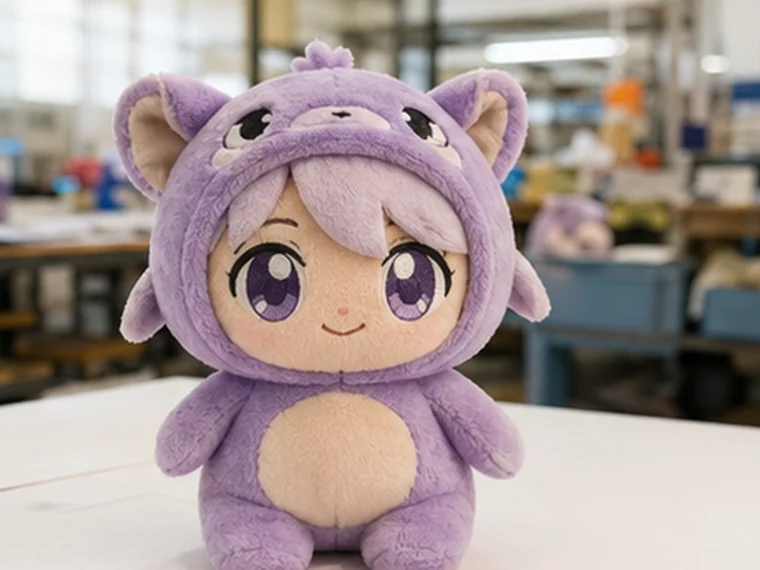
Good fit: budget and promo plush, flat graphic design languages, anime-style faces with fine linework that embroidery can’t hold, mixed approaches (printed iris detail inside an embroidered outline). Poor fit: premium gift plush where the face is the product.
How Should a Buyer Choose?
Answer two questions in order. First: could this toy reach a child under three? If yes — and “it’s sold as 3+ but it’s cute” doesn’t survive contact with a CPSC or EU market-surveillance review — design out attached parts: embroidered or printed. Age grading follows foreseeable use, not the label.
Second, if you’re genuinely 3+ or adult-collector: what does the face need to do? Glossy depth → safety eyes. Soft modern character → embroidered. Graphic flatness or tight budget → printed. Then put the choice in the spec — eye style, size, color/thread codes, and for safety eyes the component source — and lock it at the golden sample. At inspection, eye position and attachment are checked against that sample at AQL 2.5; a crooked face is the single most visible defect a plush can have.
If you’re unsure, sample two versions of the face. It’s the highest-leverage A/B in plush, and the sample fee is credited back on bulk orders of 3,000+ units anyway.
Request a Factory-Direct Quote
The first step in making your order come to life. Request a free quote with your artwork and target quantity — flag the target age range, and we’ll recommend the eye construction that fits both the design and the rules.
Frequently Asked Questions
Are plastic safety eyes safe for babies?
Generally no program should use them under age three. Safety eyes are attached rigid parts; even when they pass EN71-1/ASTM F963 tension testing, under-3 age grading scrutinizes attached components hard, and most baby programs design them out in favor of embroidered or printed eyes, which are 0+ by construction.
Which eye type is cheapest?
Printed eyes are usually cheapest because there are no components, no embroidery machine minutes, and no attachment QC step. Embroidered and safety eyes land mid-range: embroidery costs machine time, while safety eyes add a component, installation labor, and per-unit lock inspection.
Can I change the eye style after seeing the sample?
Yes, but it’s a revision round, not a tweak. Eyes are applied to flat panels before sewing, so changing style alters the panel preparation and sometimes the pattern itself. Decide the eye direction in your artwork and confirm it at the first sample.
Do embroidered eyes need safety testing?
The toy as a whole still tests to its market’s standards (EN71, ASTM F963, CPSIA — typically $150–$400 per standard per batch), but embroidered eyes remove the attachment-specific failure mode: there is no rigid part to pull off, so the small-parts question is answered by construction.
About the Author
Kyo Lue — General Manager, The Plush Maker
Kyo works directly with The Plush Maker’s pattern room, embroidery team, sewing line, and QC staff in Dongguan. His eye-construction advice comes from production decisions buyers can verify: artwork setup, panel preparation, attachment risk, age grading, and final inspection against the golden sample.